ML
Executive Summary
This section focuses on Machine Learning (ML) methods to answer our research questions. In particular, our first two goals for this section involve identifying characteristics of a Reddit post, while our last two goals are more text-based, involving Reddit post generation and summarization.
First, we focus on predicting which subreddit a post belongs to based on its text. We provide a Random Forest model for this classification task, as well as a baseline model for comparison. In doing so, we find significant improvement from the baseline model to the Random Forest model, with areas of improvement still to be addressed.
Subsequently, we attempt to predict the flairs of posts in r/AmItheA**hole (r/AITA) using various possible predictors. We apply two Random Forest models using the text of posts in r/AITA and the user engagement on these posts, respectively. Similar to our first classification task, these models perform better than a blind guess or baseline but still have much room for improvement.
Then, we aim to create a model to generate stories for new Reddit posts. We train a recurrent neural network (RNN) with a Long Short-Term Memory architecture on text from a mix of top stories from various subreddits and popular books. While the model successfully generates text demonstrating an understanding of basic linguistic structures, it has yet to produce fully cohesive stories, marking a significant step toward more complex narrative generation.
Lastly, we use a pre-trained model to summarize and understand topics selected in our project’s natural language processing portion within the r/NoStupidQuestions subreddit. With the summarization model, we identify popular comments of interest and can significantly reduce the amount of text while keeping the comment’s meaning.
These studies highlight the challenges and progress in using ML for subreddit content analysis, demonstrating advancements from simple probabilistic approaches to more sophisticated models like Random Forest and RNNs. The models have varying degrees of success, suggesting room for further improvement in these areas.
Analysis Report
Subreddit Prediction
For our subreddit prediction task, we aim to take only the textual content of a post and classify the subreddit to which that post belongs. By using the 500 most common words across all posts, we hope to obtain important textual information that helps us determine which subreddit a post belongs to. For instance, the word “relationship” may be much more likely to appear in the r/relationship_advice subreddit than any others.
Baseline Model
Before we dive into complex Machine Learning models, though, we start with a baseline model. The baseline model provides us with a point of comparison for our more complex Machine Learning models, allowing us to evaluate the performance of those models in comparison to the simple baseline. Our baseline model is very naïve - it simply predicts subreddits with probability equal to the proportion with which they make up the training dataset. For instance, if 50% of our training dataset contains observations from r/relationship_advice, 30% from r/NoStupidQuestions, and 20% from r/TrueOffMyChest, our baseline model will predict that a post belongs to the subreddit r/relationship_advice with probability 0.50, the subreddit r/NoStupidQuestions with probability 0.30, and the subreddit r/TrueOffMyChest with probability 0.20. In this case, of course, the model has 12 subreddits to choose from, each with their own associated probabilities. Note that the baseline model does not consider additional information, such as the textual content of the post, because it is so simple.
Random Forest Model - Full Dataset
In order to predict the subreddit to which a post belongs more effectively, we turn to the Random Forest. The Random Forest model is an ensemble method that constructs multiple “weak” classifiers, known as Decision Trees and aggregates them to make decisions based on the data provided.
In our case, we seek to construct a Random Forest that analyzes the word usage in a given Reddit post to decide which subreddit that post belongs to. For instance, the Random Forest may determine that if a post mentions the word “relationship” more than three times, it belongs to the r/relationship_advice subreddit. Similarly, it might decide that a combination of the use of the words “work”, “job”, and “hate” in a post indicates that the post belongs to the r/antiwork subreddit. Note that the Random Forest model does consider the information present in the dataset, unlike the baseline, because it uses all present data to inform its decisions, rather than simply making a random guess.
Random Forest Model - Balanced Dataset
Although the Random Forest model is a promising prospect for classifying the subreddit to which each of our Reddit posts belongs, some concerns may arise. Given the vast class imbalance present in the dataset - for example, r/relationship_advice has approximately 100 times as many posts as r/AskWomen - we fear that the Random Forest model might learn to predict the more prevalent classes and ignore the less prevalent ones. For this reason, we employ a technique that can help address the imbalance of subreddit classes.
Here, we decide to build a Random Forest model that is built upon a balanced representation of our dataset. To do so, we sample posts from each subreddit such that the number of posts in our dataset is roughly equivalent to the presence of the least common subreddit. Balancing the dataset in this way allows us to build a model that is not biased toward the overwhelming presence of one subreddit or another. However, it should be noted that this downsampling technique forces us to set aside a considerable portion of our data to adhere to the least prevalent subreddit.
Results
Here, we explore the results of our collection of models in performing the subreddit prediction task.
Results - Baseline Model
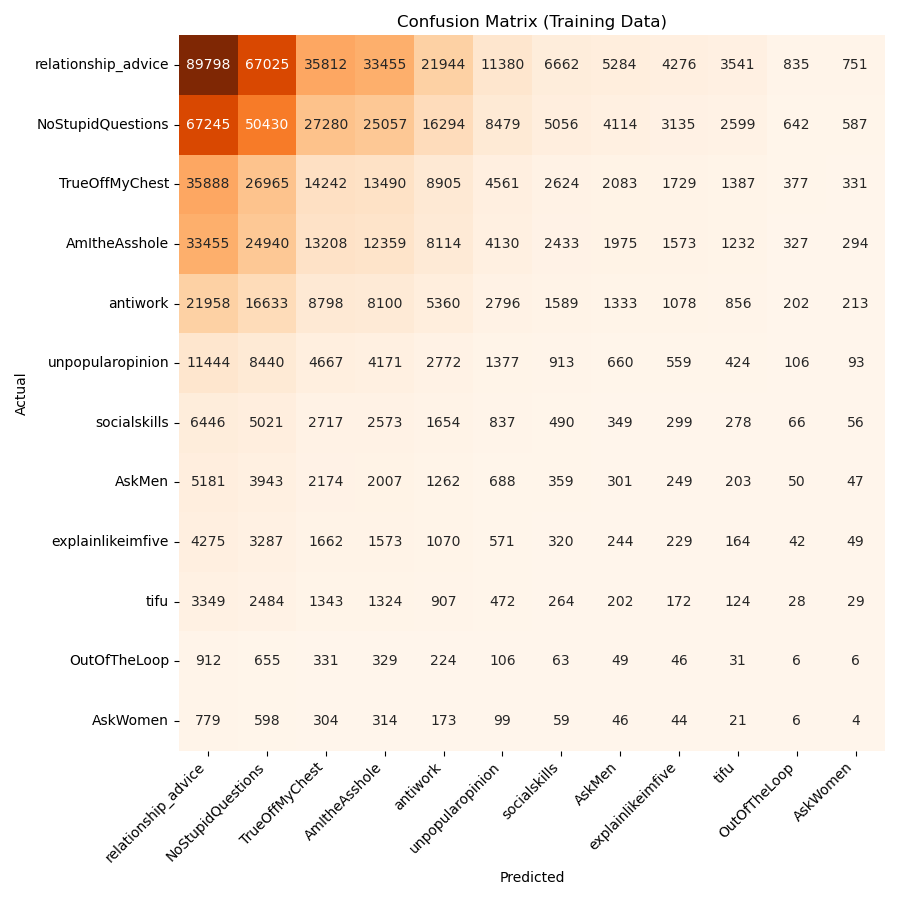
Below, in Figure 1, we can see the results of the baseline model predictions on the training data. As expected, the model predicts the more prevalent subreddits, such as r/relationship_advice and r/NoStupidQuestions, more often. Since the model only predicts subreddits proportionally to how they appear in the training data, it does not do a good job of actually identifying these subreddits correctly. In fact, its expected classification accuracy is equal to the sum of the squares of the probabilities with which each subreddit occurs, which amounts to approximately 0.20.
Results - Random Forest Model - Full Dataset
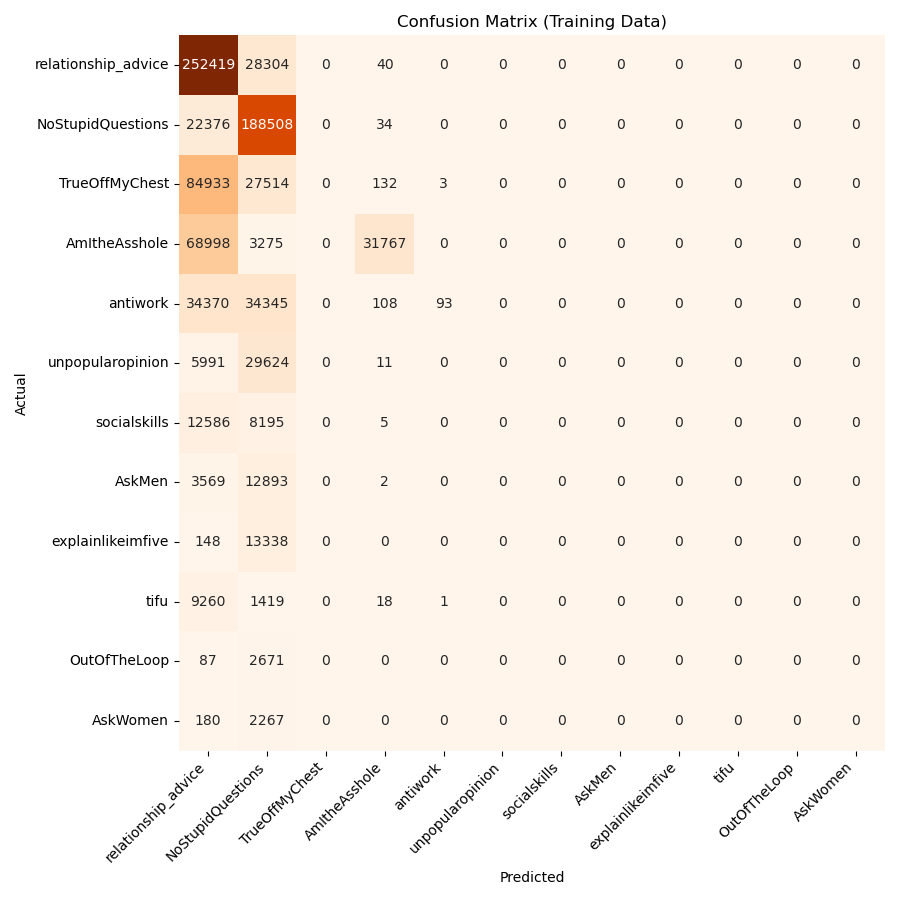
Below, in Figure 2, we can see the results of the Random Forest model predictions on the training data. Here, the model outperforms the baseline model but still has its downfalls. The model predicts the two most prevalent subreddits, r/relationship_advice and r/NoStupidQuestions, nearly every time, failing to predict any less prevalent subreddits. In this sense, the model is vastly underperforming, as it is heavily biased to the subreddits it has seen more often.
Results - Random Forest Model - Balanced Dataset
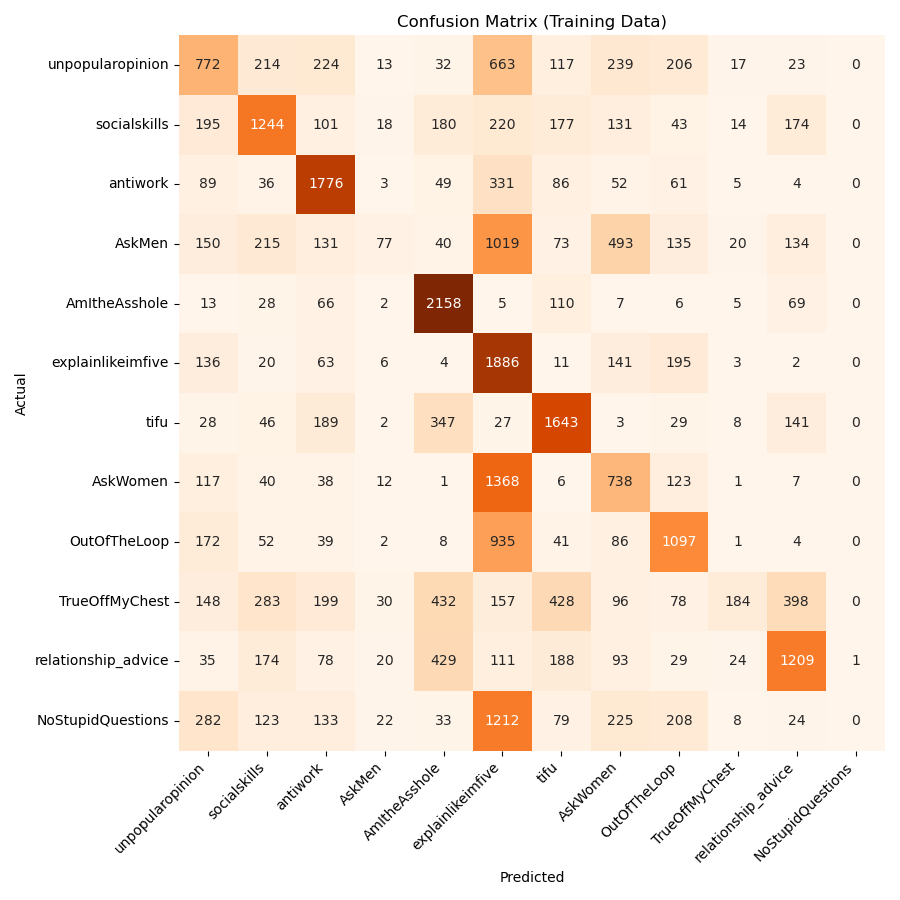
Below, in Figure 3, we can see the results of the Random Forest model predictions on the downsampled, balanced training data. Here, the model predicts each subreddit some number of times without really avoiding any of them, as it did with the full, unbalanced dataset. For most subreddits, the model correctly predicts the subreddit most often. However, there are still many instances where the model predicts incorrectly, especially in subreddits like r/AskMen and r/NoStupidQuestions.
Results - Evaluation Metrics
Below, in Figure 4, we can see the evaluation metrics for the three multi-class classification models described above. These metrics include:
- Accuracy: a measure of how often the model correctly classified the subreddit to which a post belongs
- F1-Score: the harmonic mean between the precision and recall scores (below)
- Weighted Precision: a weighted measure of how often the model correctly classified the subreddit to which a post belongs, given that it predicted a particular subreddit
- Weighted Recall: a weighted measure of how often the model correctly classified the subreddit to which a post belongs, given that the post belongs to a particular subreddit
By comparing each model type, we find that the baseline model vastly underperforms when compared to the Random Forest models. However, almost surprisingly, we find that the Random Forest Model trained on the full, unbalanced dataset outperforms the downsampled, balanced dataset by as much as 10% across all evaluation metrics. The balanced dataset likely exhibits a trade-off between the amount of data and the balance of subreddit classes that did not pay off. In any case, it is great to see that our machine learning models significantly outperform the baseline model for this task. However, we would like to improve this model further while maintaining all twelve storytelling subreddits.
The code used for this section is available here.
Flair Prediction Using Random Forest Classification
In this section, we attempted to predict what flair is assigned to posts in r/AmItheA**hole (r/AITA) based on various predictors using a Random Forest (RF) model to attempt to predict how Redditors “judge” these stories posted on r/AITA. We then compared these models’ varying predictors to a baseline (random chance) model.
We applied the first RF model to the r/AITA data using token counts of the five hundred most common words extracted using CountVectorizer in the NLP section previously. We chose fifty trees as our hyperparameter to be used across all models used in this section to allow for consistent comparisons. However, due to the imbalanced nature of the r/AITA posts (as established in the EDA section of this project), the dataset was downsampled so that none of the four primary flairs (A**hole, Not the A-hole, Everyone Sucks, No A-holes here) are overrepresented to the extent that they would significantly hinder model performance. After a training and testing data split, the model was trained on the training subset, and various model metrics were calculated for both the training and testing subsets via a SparkML pipeline. Measures and visualizations of this model’s efficacy are displayed below.
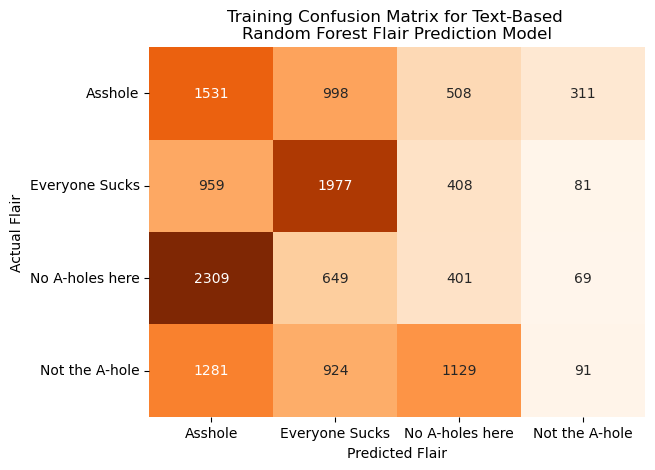
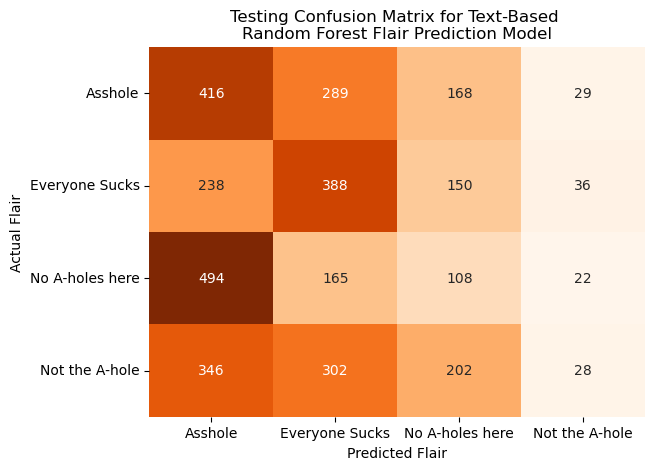
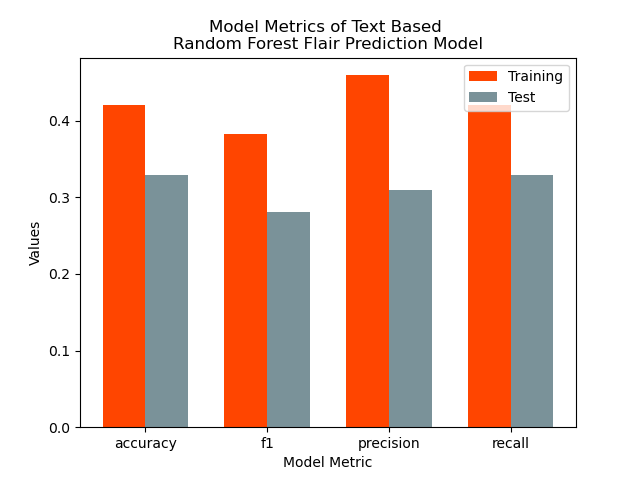
Based on the metrics above, this model did not predict the flairs of these posts particularly accurately, but performed better than a blind random guess, which would have a theoretical accuracy of 25% compared to our model’s ~30-40%. For both the training and testing subsets, the model did an extremely poor job at predicting “Not the A-hole posts”. This model does perform reasonably well when predicting “Everyone Sucks” and “_A**hole_” flaired posts, but does not predict the posts with the more positively connoted flairs (No A-holes here and Not the A-hole).
Another potential set of predictors we identified were measures of user engagement, namely post “score” (number of upvotes minus number of downvotes) and the number of comments under a post. We applied a similar model using these predictors via another SparkML pipeline and compared them to the previous text-based model. The measures of model performance and confusion matrices are visualized below as such.
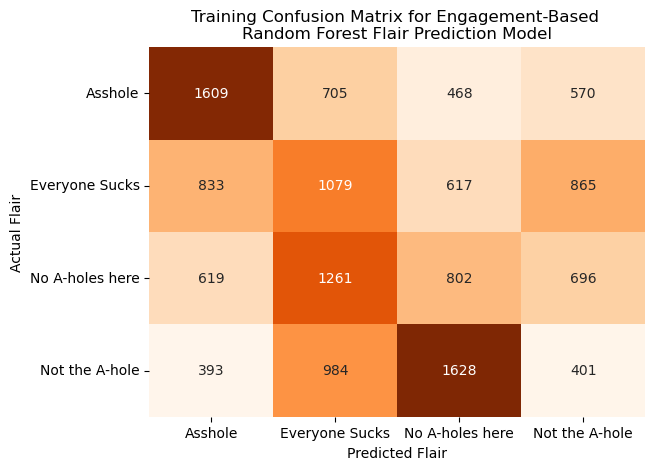
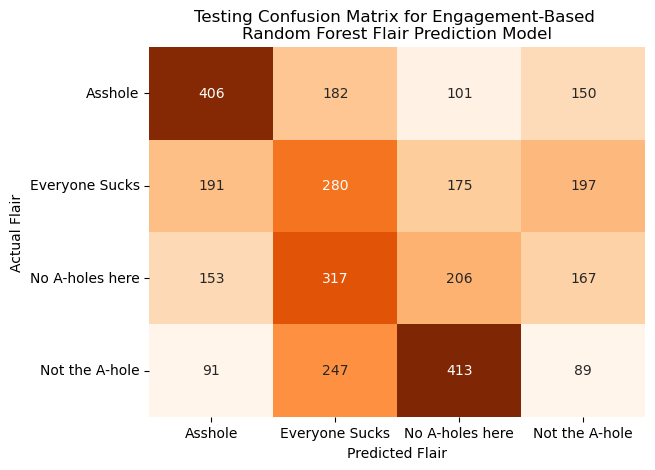
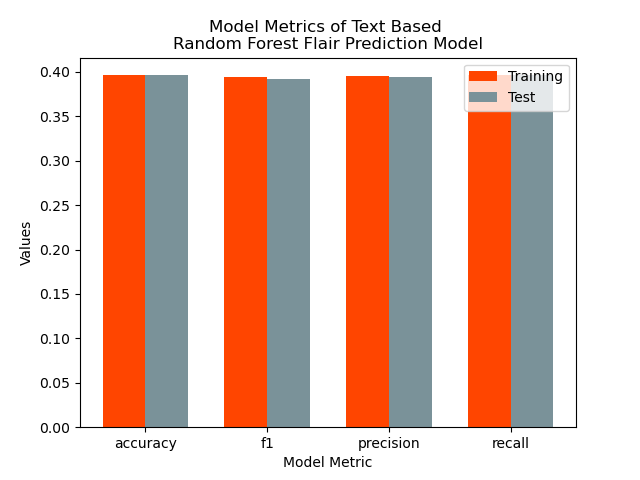
As shown above, this model performs fairly similarly to the previous text-based model but with some slight improvements in some of the model performance metrics and more comparative performance metrics for the training and test sets. This model more effectively predicted posts with the flairs “_A**hole_” and “Everyone Sucks” compared to the text-based model but similarly struggled to identify posts with more positive flairs correctly. Ultimately, while this model does perform slightly better than the previous text-based model, especially at predicting the posts with more negative flairs attached, it still would not serve as an effective tool for accurately predicting these flairs on a larger scale. These data may be too homogeneous to be easily differentiated using a machine learning model, or using different models or hyperparameters may generate more accurate predictions.
We also include the evaluation metrics in Table 1 below:
| Metric | Engagement Training | Engagement Test | Text Training | Text Test |
|---|---|---|---|---|
| accuracy | 0.396378 | 0.396137 | 0.420226 | 0.329193 |
| f1 | 0.393809 | 0.392595 | 0.382704 | 0.28115 |
| precision | 0.395841 | 0.394806 | 0.459258 | 0.309424 |
| recall | 0.396378 | 0.396137 | 0.420226 | 0.329193 |
The code used for this section is available here.
Story Generation
Note
The saved model used for this section is available here.
We developed a story generation model using a Recurrent Neural Network (RNN) model to address our goal of crafting stories that Reddit’s audience finds engaging. We built and trained the model using PySpark and PyTorch. To enhance the computation speed, we integrated CUDA into the process. Our data is the mix of top stories from various subreddits and popular books sourced externally, developed during the NLP portion of the project. The preprocessed portion of the dataset usable for training purposes is 1037 MB. We found that a smaller subset of 160.59 MB was adequate for the analysis.
The model’s architecture is based on a Long Short-Term Memory (LSTM) layer, which captures long-term dependencies in sequential data. In our setup, we defined hyperparameters such as the input size of 128, hidden state at 256, and used a two-layer LSTM. The model has 12,766,510 trainable parameters.
For the training process, we set the learning rate at 0.01, a maximum of 100 epochs, and a batch size of 64. To ensure the model didn’t overfit, we employed an early stopping mechanism with a patience of 5 epochs and a validation loss improvement threshold of 0.01. The Adam optimizer was chosen for optimization, paired with a cross-entropy loss function for calculating the model’s error rate. The total training time was 1h 41 mins.
The training and validation perplexities are shown in Figure 11:
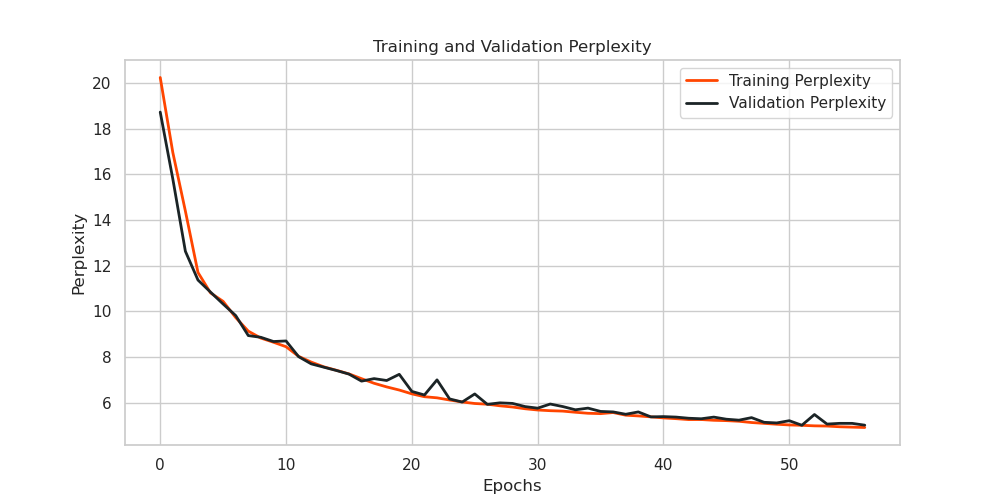
To evaluate the model’s effectiveness, we focused on loss and perplexity. A lower perplexity value suggests a higher predictive accuracy of the model. The model achieved a test loss of 1.6227 and a perplexity value of 5.0667, indicating a strong performance in predictive capabilities.
We were ready to generate stories with the trained model. Some examples are shown in Table 2:
| Prompt | Generated Text |
|---|---|
| Once upon a time | Once upon a time to of a cause the gachen friends these any olden lands. it was the school all as the sach could boypheal, and they letes saying cut that ended about the told the asking.the said she so a kyastellow specially will wrong me have a glories and how in s |
| The sun set over the ancient, whispering forest | The sun set over the ancient forest and the sating the told the thought the pressated the hassed has all she was hands and the and the and of didnt conday her that there you hands my like i was the and i was the told when and the put all into the done to the down the sately and stouse |
| The sound of sirens pierced the night | The sound of sirens pierced the night stack and the down, my fear that my bly and were expetes his slaring when it becheads icky that my feelt and want and contores she givated hours. we let me processings that i only and low that on a mord of the past finding to this because oulling th |
As we can see in the above table, the text generated still doesn’t construct sentences with the appropriate structure to be considered stories. Nonetheless, although our model cannot yet generate cohesive stories, it’s important to recognize the success of the underlying process. We trained the model only on individual characters, and the learning process allowed it to piece together coherent words and phrases. This ability demonstrates the model’s understanding of basic linguistic structures, a foundational step toward more complex story generation. This aspect of the model’s output aligns well with the objectives of our project. Future work will include leveraging the text generation capabilities of transformer models, which are better suited for this use case. With these, we aim to produce compelling stories crafted from training data from the best Reddit and broad literature storytelling.
For complementary purposes only, we imagine what illustrations of our generated stories would look like using DALLE-3. Below, in Figure 12, are illustrations corresponding to each of the generated stories shown above.



The code used for this section is available here.
Top Comment Summary Generation
One of the biggest stories in recent history is COVID-19. Our NLP work identified the top comments related to COVID-19 within the subreddit r/NoStupidQuestions and then we wanted to summarize these comments to capture that story while greatly reducing the time it would take to read and comprehend it. To do this, we used an open-source model from Huggingface and tuned the hyperparameters to keep the new summaries at 25% of the original text length as a minimum, with 15 tokens of cushion on the maximum length parameter.
A major hurdle in evaluating the performance of our model is that reference summaries would be needed. To generate the reference summaries, an API call to GPT-4 was used. Once we had reference summaries, we were able to generate ROUGE scores to better understand the open-source model’s performance.
Below is a plot of the ROUGE (Recall-Oriented Understudy for Gisting Evaluation) scores. In this case, our open-source model is the one being evaluated and the reference summaries are from GPT-4. The plots below show multiple scores to get a more holistic understanding of the model’s performance.
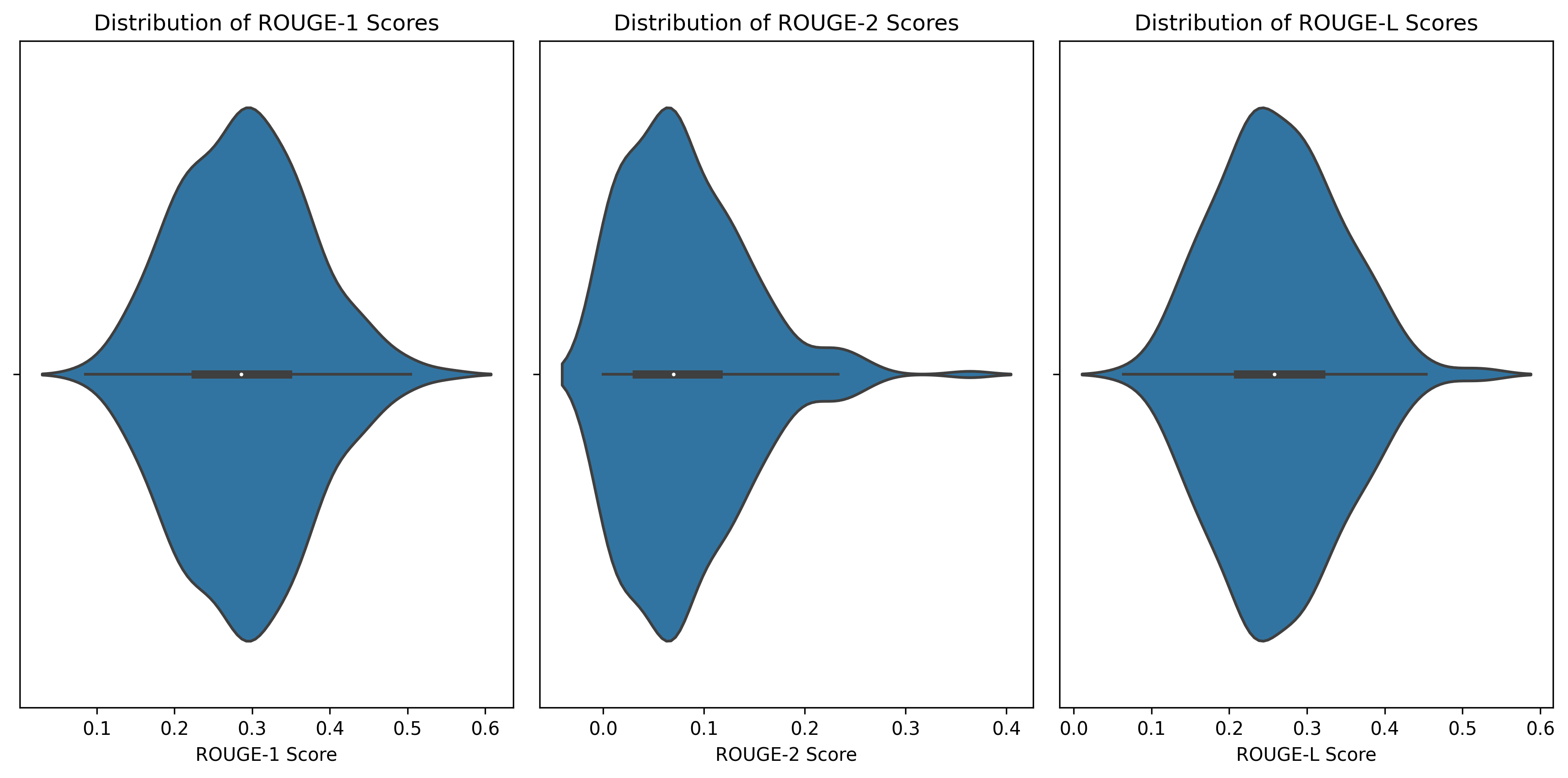
Below is an example of our model’s summarization ability on a Reddit post within r/NoStupidQuestions that references an article, which can be found on this site. It is clear that the summarizer does a great job of extracting key information from the article, making sure to summarize it with a length that is roughly 25% of the length of the article itself.
Before Summarization (After Stemming and removing StopWords):
I can understand that frustration and getting tired of the cynicism or generation of toxic beliefs, but it should be noted that about that bit from his 1999 special about the immune system and all that, his family has outright said:
Several times during the pandemic, Carlin has drawn attention for a routine from his 1999 special, “You Are All Diseased,” in which he mischievously suggests that a childhood spent swimming in the polluted Hudson River was the reason he didn’t catch polio.
(“In my neighborhood, no one ever got polio,” he fulminates. “No one, ever. You know why? ’Cause we swam in raw sewage. It strengthened our immune systems. The polio never had a prayer.”)
As Kelly Carlin explained, some viewers concluded — wrongly — that her father would have opposed coronavirus vaccines.
“Everyone’s like, see? George Carlin would have been anti-vaccination,” she said. “And I’m like, no. My dad was pro-science, pro-rational thinking, pro-evidence-based medicine. The man was a heart patient for 30 years. When he was a kid and the polio vaccine became available, he got the polio vaccine.”
…
In efforts to divine his opinion, some Carlin fans pointed to a 1990 interview he gave to Larry King, when he expressed his misgivings about the crude standup of Andrew Dice Clay: “His targets are underdogs, and comedy has traditionally picked on power — people who abuse their power,” Carlin said at the time.
Kelly Carlin said her father “always took the stand that more speech is better than less speech” and would have supported Chappelle’s right to perform the special. But, she added, “if you’re a comedian, you’ve got to be funny.”
After Summarization:
Carlin has drawn attention for a routine from his 1999 special, “You Are All Diseased.” He mischievously suggests that a childhood spent swimming in the polluted Hudson River was the reason he didn’t catch polio. Some viewers concluded — wrongly — that her father would have opposed coronavirus vaccines. “Everyone’s like, see? George Carlin would have been anti-vaccination,” she said. ’I’m like, no. My dad was pro-science,. pro-rational thinking, pro-evidence-based medicine.
The model used to perform this summarization was a “facebook/bart-large-cnn” [1].
The code used for this section is available here.
References
[1]
Lewis M, Liu Y, Goyal N, Ghazvininejad M, Mohamed A, Levy O, Stoyanov V, Zettlemoyer L. BART: Denoising Sequence-to-Sequence Pre-training for Natural Language Generation, Translation, and Comprehension. 2019 [accessed 2023 Nov 30]. https://arxiv.org/abs/1910.13461. doi:10.48550/ARXIV.1910.13461